0.3 Wh
A typical short text answer.
About what a desk lamp draws in a minute. Older estimates ran roughly ten times higher. Newer models are more efficient, though longer reasoning answers cost a good deal more. 1
Please consider the cost before you ask a machine to think for you.
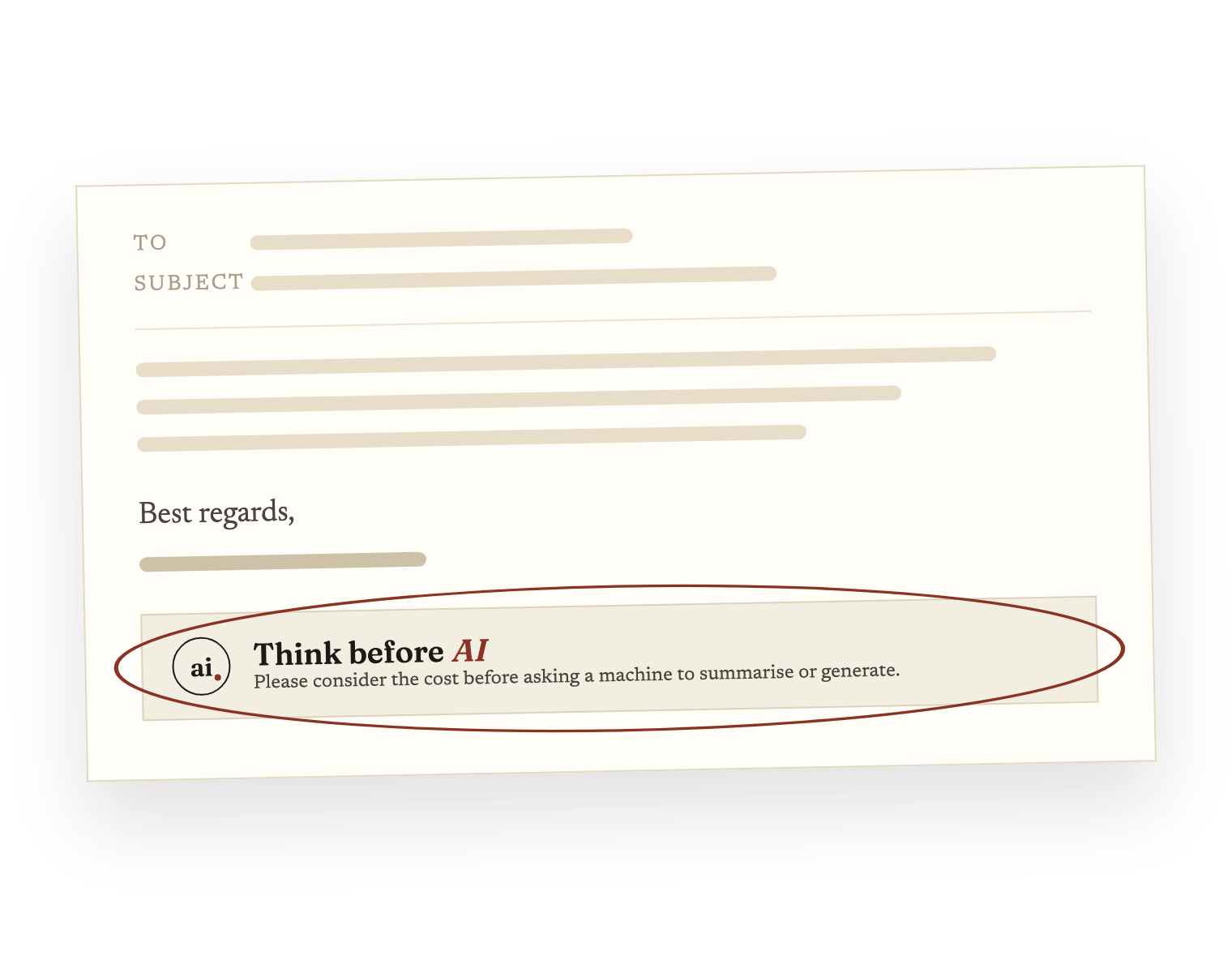
We are not against AI. We are against using it without thinking.
You have seen the footer on a thousand emails: . This is the same idea, for a newer habit. We do not know whether a quiet reminder changes much, but we think it is worth trying.
A language model is a useful tool. For a simple question it is also often a higher-energy way to get an answer than reading, searching, or working it out — and we often reach for it on reflex. We use it to summarise something we could have read, or to draft something we could have written ourselves.
The cost of a single answer
That is the problem. One request is small enough that we never think about it, and we make billions of them. The figures below are estimates. They vary with the model, the length of the prompt, and where each study draws the line. Every one is cited.
0.3 Wh
A typical short text answer.
About what a desk lamp draws in a minute. Older estimates ran roughly ten times higher. Newer models are more efficient, though longer reasoning answers cost a good deal more. 1
33+ Wh
One long prompt to a reasoning model.
In a 2025 benchmark the heaviest reasoning models used more than thirty-three watt-hours for a single long prompt, while an efficient model on the same task used only a couple. The high end is about a minute of an electric oven for one reply. 2
500 ml
A bottle of water, every few dozen replies.
Counting the water used to cool the data centre and to make its electricity, an older model like GPT-3 worked out at roughly ten to fifty short replies for each 500 ml bottle — tens of millilitres apiece, and it depends where the data centre sits. Efficient newer models use less. 3
1–10 ×
Compared with a plain web search.
How much more than a web search? It depends. An efficient text model can be close to par; an older or heavy-reasoning answer can run several times higher. The often-quoted “ten times” came from earlier, less efficient models and now looks like an overestimate. 1 ,4
And then there is the scale
Your one summary will not melt a glacier. A billion reflexive summaries are a different matter, and that is the scale we now operate at.
Beyond the obvious
The obvious cases are not the whole story. Often it is something smaller. You summarise an article that is already open in the next tab. You generate three paragraphs to answer a question you could have answered in one line. You ask a model to take a first pass you could easily have done yourself.
All of this is convenient. It also has a cost you never see on the screen, and a second cost that is quieter still. Every time you hand over a small piece of thinking, you get a little less practice at doing it yourself.
A fair question
An honest answer: printing one page is usually worse for the planet than asking a model to summarise it. A sheet of A4 costs around five grams of CO2 in the making and between two and thirteen litres of water, nearly all of it in the paper itself.6,7 A short summary on an efficient model is roughly a tenth of a gram of CO2 and a few millilitres of water.1,3
Printing the page
~5 g CO22 to 13 litres of water
Summarising it
~0.15 g CO2a few millilitres of water
So why this campaign? Two reasons. Hand a long document to a large reasoning model and one answer can use enough to rival a printed page. And we do not print billions of pages a day out of habit, but we do ask billions of questions that way, and many of them never needed asking. The cheapest page is the one you read yourself, on the screen already in front of you.
A short habit
We are not bossy
We are asking people to think before they prompt, not telling them they have to. Use AI for the things it is good at, and skip it for the things you can do yourself. That is the whole campaign.
“Think before AI. Could I read it, write it, or work it out myself? thinkbeforeai.org”
Paste it into an email signature, a team channel, or a sticky note on your monitor.
Resources

A small banner for the bottom of your emails, the way the old reminder about printing once spread. It links back here.
Get your email banner
Paste this badge into your own footer to point visitors at the campaign.
<a href="https://thinkbeforeai.org/" rel="noopener">
  <img src="https://thinkbeforeai.org/badge.png" alt="Think before AI" width="190" height="44" style="border:0">
</a>